Download species occurrence data from GBIF
sp_occurrence.RdDownload data from the Global Biodiversity Information Facility (GBIF) data portal.
sp_genus returns a data.frame with all the species names associated with a genus.
sp_occurrence downloads occurrence records for a single species.
You can check the number of records returned by using the option download=FALSE.
Note that the you can only download up to record number 100,000. To avoid getting more than 100,000 records, you can do separate queries for different geographic areas. This has been automated in sp_occurrence_split. This function recursively splits the area of interest into smaller areas until the number of records in an area is less than 50,000. It then downloads these records and saves them in a folder called "gbif". After all areas have been evaluated, the data are combined into a single file and returned as a data.frame or SpatVector). If the function is interrupted, it can be run again, and it will resume where it left off.
If you want to download data for an entire genus, first run sp_genus and then download data for the returned species names one by one.
Before using this function, please first check the GBIF data use agreement and see the note below about how to cite these data.
sp_genus(genus, simple=TRUE, ...)

sp_occurrence(genus, species="", ext=NULL, args=NULL, geo=TRUE,
  removeZeros=FALSE, download=TRUE, ntries=5, nrecs=300,
  start=1, end=Inf, fixnames=TRUE, sv=FALSE, ...)

sp_occurrence_split(genus, species="", path=".", ext=c(-180,180,-90,90),
  args=NULL, geo=TRUE, removeZeros=FALSE, ntries=5, nrecs=300,
  fixnames=TRUE, prefix=NULL, sv=FALSE, ...)
Arguments
- genus
character. genus name
- species
character. species name
- ext
SpatExtent object to limit the geographic extent of the records. A SpatExtent can be created using functions like
extanddraw- args
character. Additional arguments to refine the query. See query parameters in http://gbif.org/developer/occurrence for more details
- geo
logical. If
TRUE, only records that have a georeference (longitude and latitude values) will be downloaded- removeZeros
logical. If
TRUE, all records that have a latitude OR longitude of zero will be removed ifgeo==TRUE, or set toNAifgeo==FALSE. IfFALSE, only records that have a latitude AND longitude that are zero will be removed or set toNA- download
logical. If
TRUE, records will be downloaded, else only the number of records will be shown- ntries
integer. How many times should the function attempt to download the data, if an invalid response is returned (perhaps because the GBIF server is very busy)
- nrecs
integer. How many records to download in a single request (max is 300)?
- start
integer. Record number from which to start requesting data
- end
integer. Last record to request
- fixnames
If
TRUEa few unwieldy and poorly chosen variable names are changed as follows. "decimalLatitude" to "lat", "decimalLongitude" to "lon", "stateProvince" to "adm1", "county" to "adm2", "countryCode" to "ISO2". The names in "country" are replaced with the common (short form) country name, the original values are stored as "fullCountry"- path
character. Where should the data be downloaded to (they will be put in a subdirectory "gbif")?
- prefix
character. prefix of the downloaded filenames (best left NULL, the function will then use "genus_species"
- simple
logical. If
TRUE, a vector the accepted species names are returned. Otherwise a data.frame with much more information is returned- sv
logical. If
TRUE, a SpatVector rather than a data frame is returned.- ...
additional arguments passed to
download.file
Value
data.frame, or SpatVector if sv=TRUE
Note
Under the terms of the GBIF data user agreement, users who download data agree to cite a DOI. Citation rewards data-publishing institutions and individuals and provides support for sharing open data [1][2]. You can get a DOI for the data you downloaded by creating a "derived" dataset. For this to work, you need to keep the "datasetKey" variable in your dataset.
Examples
sp_occurrence("solanum", "acaule", download=FALSE)
#> Loading required namespace: jsonlite
#> [1] 5070
g <- sp_occurrence("Solanum", "acaule", geo=TRUE, end=5)
#> 5 records found
#> 1-
#> 5
#> 5 records downloaded
# \donttest{
sp_occurrence("Batrachoseps", "luciae", down=FALSE)
#> [1] 2413
g <- sp_occurrence("Batrachoseps", "luciae", geo=TRUE, end=5)
#> 5 records found
#> 1-
#> 5
#> 5 records downloaded
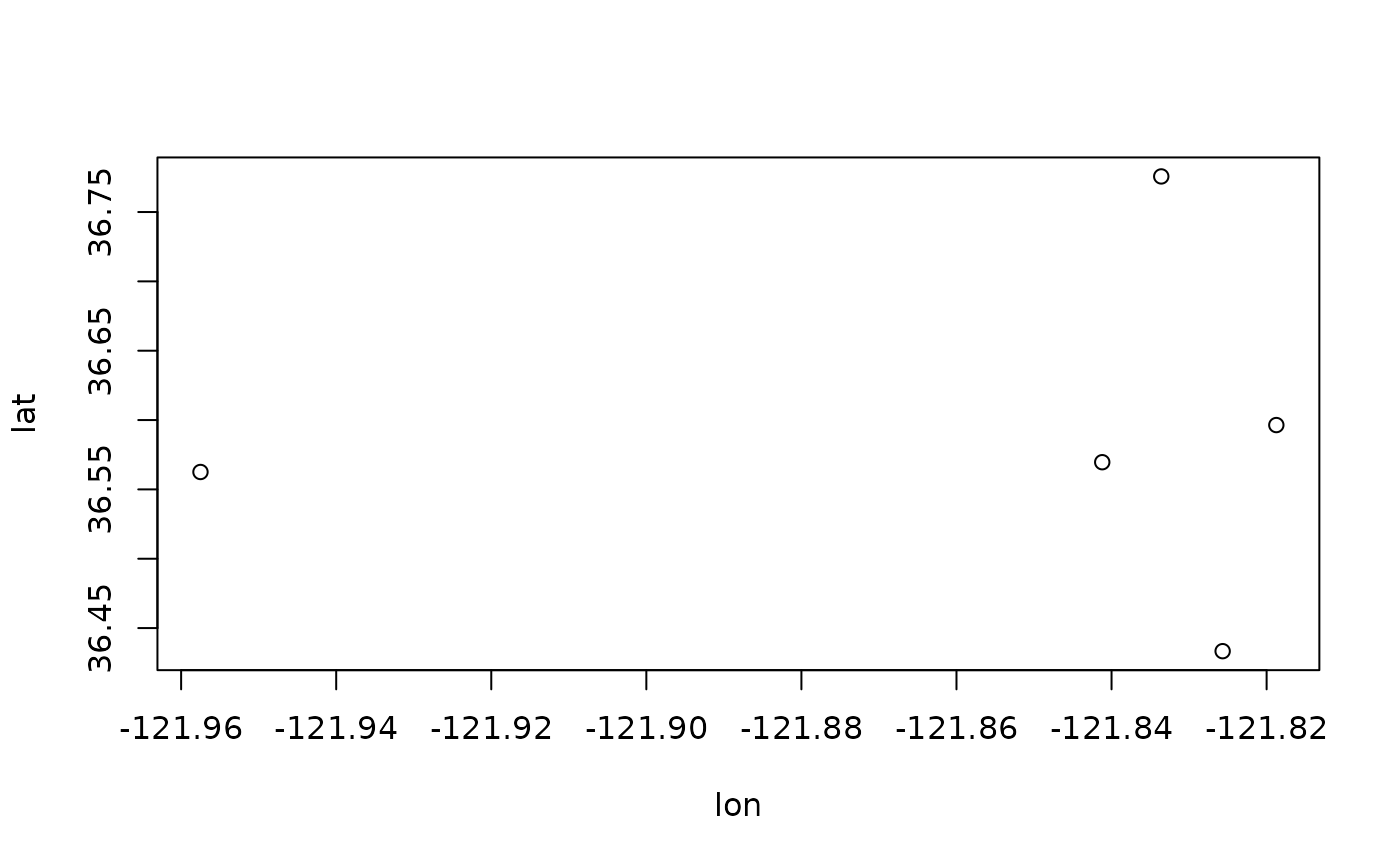
plot(g[, c("lon", "lat")])
 ## args
a1 <- sp_occurrence("Elgaria", "multicarinata",
args="recordNumber=Robert J. Hijmans RH-2")
#> 1 records found
#> 1-
#> 1
#> 1 records downloaded
a2 <- sp_occurrence("Batrachoseps", "luciae",
args=c("year=2023", "identifiedBy=Anthony Ye"))
#> 10 records found
#> 1-
#> 10
#> 10 records downloaded
## year supports "range queries"
a3 <- sp_occurrence("Batrachoseps", "luciae",
args=c("year=2020,2023", "identifiedBy=Kuoni W"))
#> 57 records found
#> 1-
#> 57
#> 57 records downloaded
table(a3[,c("year")])
#>
#> 2021 2022 2023
#> 1 42 14
# }
## args
a1 <- sp_occurrence("Elgaria", "multicarinata",
args="recordNumber=Robert J. Hijmans RH-2")
#> 1 records found
#> 1-
#> 1
#> 1 records downloaded
a2 <- sp_occurrence("Batrachoseps", "luciae",
args=c("year=2023", "identifiedBy=Anthony Ye"))
#> 10 records found
#> 1-
#> 10
#> 10 records downloaded
## year supports "range queries"
a3 <- sp_occurrence("Batrachoseps", "luciae",
args=c("year=2020,2023", "identifiedBy=Kuoni W"))
#> 57 records found
#> 1-
#> 57
#> 57 records downloaded
table(a3[,c("year")])
#>
#> 2021 2022 2023
#> 1 42 14
# }