
Check or fix polygon or extent validity
is.valid.RdCheck the validity of polygons or attempt to fix it. Or check the validity of a SpatExtent.
Usage
# S4 method for class 'SpatVector'
is.valid(x, messages=FALSE, as.points=FALSE)

# S4 method for class 'SpatVector'
makeValid(x, buffer=FALSE)

# S4 method for class 'SpatExtent'
is.valid(x)
Arguments
- x
SpatVector or SpatExtent
- messages
logical. If
TRUEthe error messages are returned- as.points
logical. If
TRUE, it is attempted to return locations where polygons are invalid as a SpatVector or points- buffer
logical. If
TRUEthe zero-width buffer method is used to create valid polygons. Be careful when using this method because it may result in data loss. For example, only a single part of a self-intersecting may be preserved. See the example below
Examples
w <- vect("POLYGON ((0 -5, 10 0, 10 -10, 0 -5))")
is.valid(w)
#> [1] TRUE
w <- vect("POLYGON ((0 -5, 10 0, 10 -10, 4 -2, 0 -5))")
is.valid(w)
#> [1] FALSE
is.valid(w, TRUE)
#> valid reason
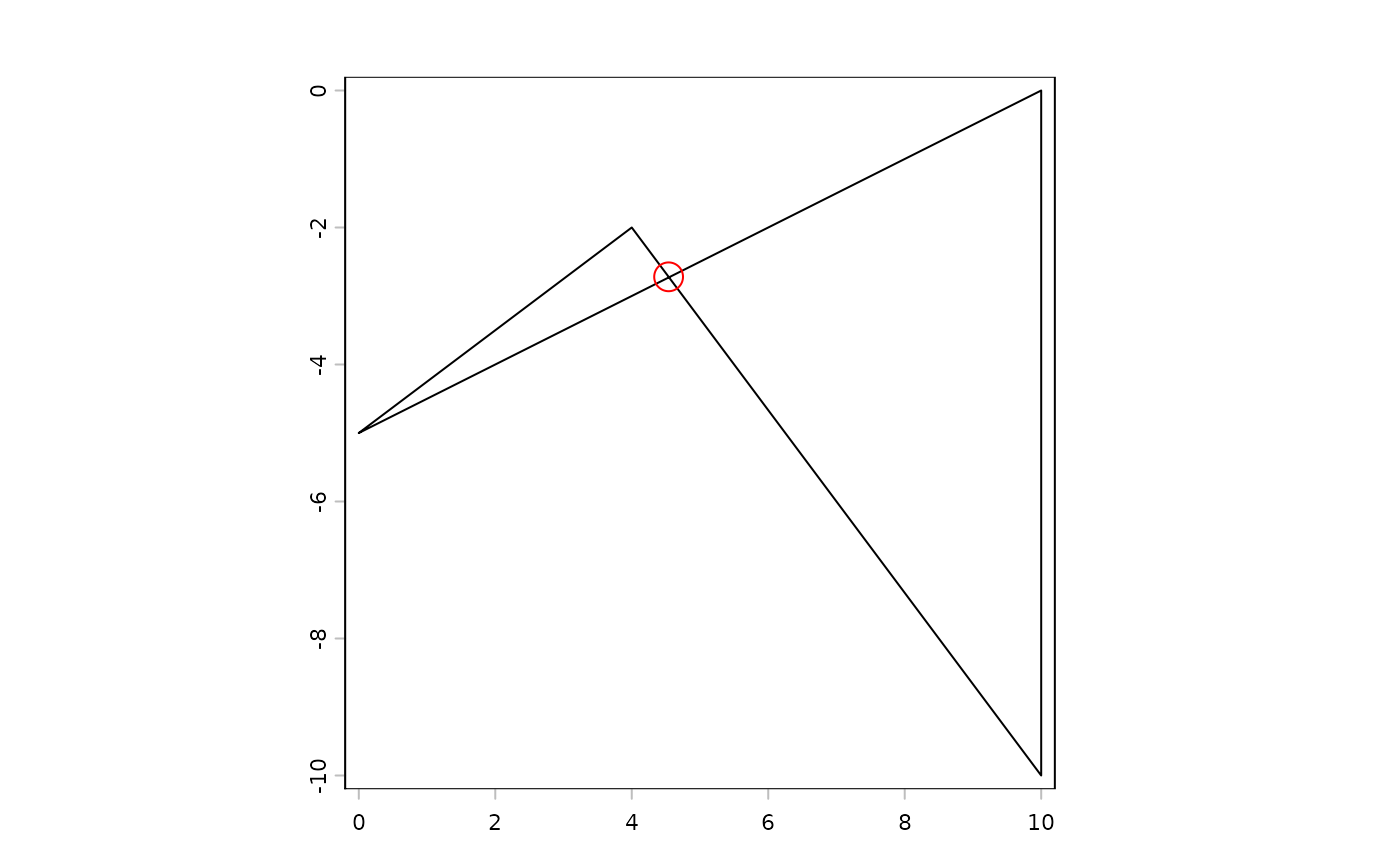
#> 1 FALSE Self-intersection[4.54545454545454 -2.72727272727273]
v1 <- makeValid(w)
is.valid(v1)
#> [1] TRUE
v2 <- makeValid(w, buffer=TRUE)
plot(disagg(v1), col=c("light blue", "gray"))
# valid but incomplete
lines(v2, col="red", lwd=3)
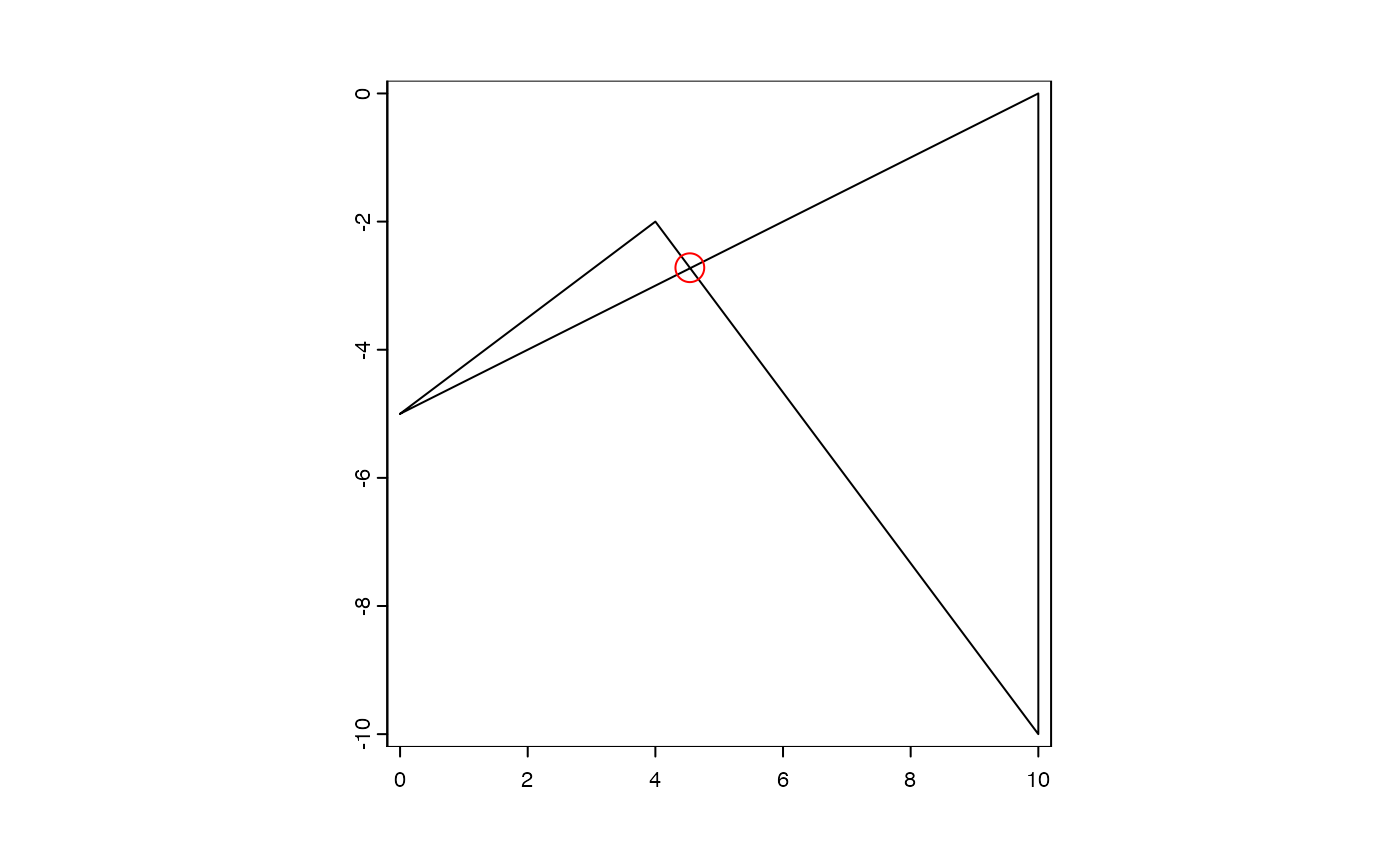 plot(w)
points(cbind(4.54, -2.72), cex=2, col="red")
plot(w)
points(cbind(4.54, -2.72), cex=2, col="red")
 e <- ext(0, 1, 0, 1)
is.valid(e)
#> [1] TRUE
ee <- ext(0, 0, 0, 0)
is.valid(ee)
#> [1] TRUE
e <- ext(0, 1, 0, 1)
is.valid(e)
#> [1] TRUE
ee <- ext(0, 0, 0, 0)
is.valid(ee)
#> [1] TRUE